
Urethral Stricture Disease
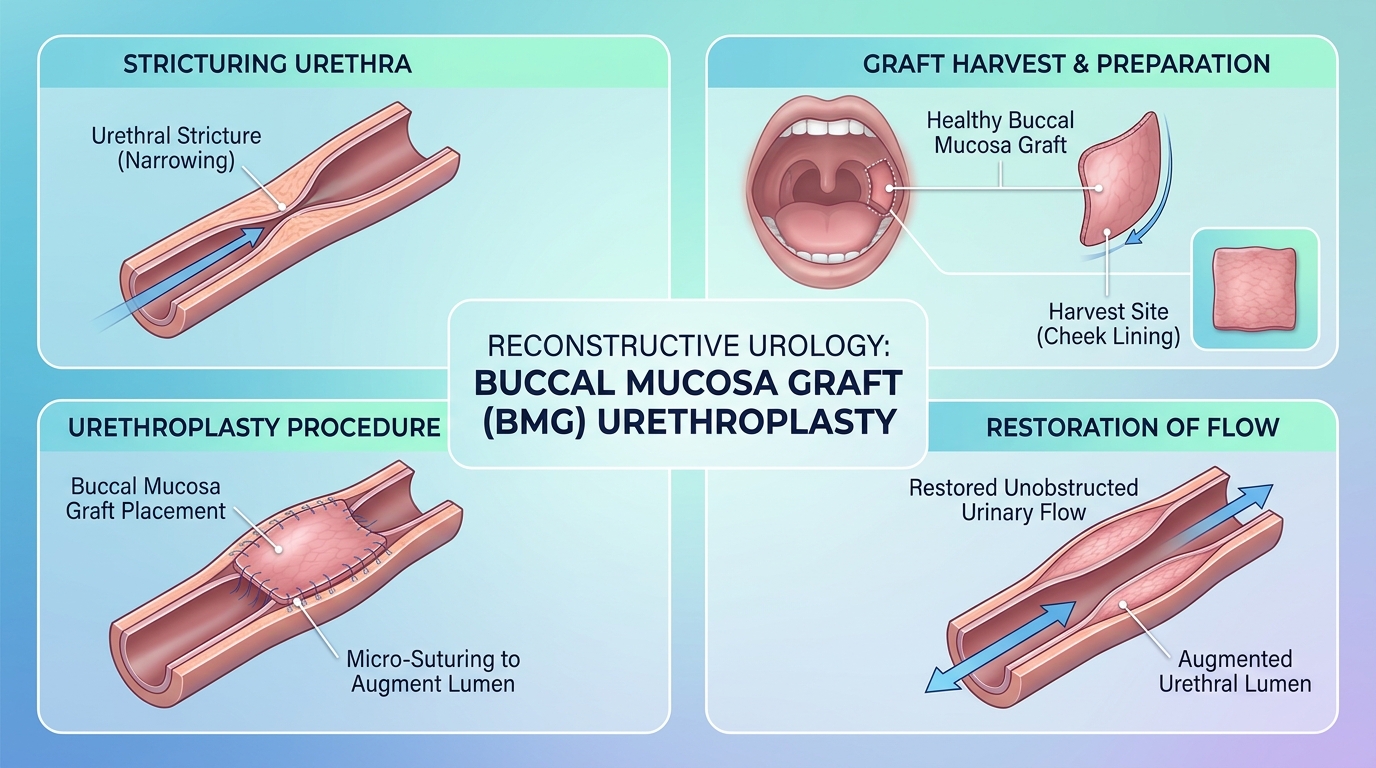
Definitive reconstruction via Buccal Mucosal Graft (BMG) Urethroplasty.
📋 Clinical Procedure Highlights
- Department: Soni Hospital Advanced Urology & Endosurgery Centre, Ramdaspeth, Nagpur.
- Surgical Technique: Minimally invasive laser, endoscopic, or microscopic intervention with tissue preservation.
- Anesthesia & Safety: State-of-the-art anesthesia with comprehensive pre-operative medical optimization.
- Insurance / TPA: Cashless claim pre-authorization supported for all major health insurance providers.
📋 Key Clinical Takeaways: Urethral Stricture
- Avoid the Cycle of Repeated Dilatations: Repetitive stretching or internal cutting (DVIU) fails in >80% of strictures and worsens spongiofibrosis scarring.
- BMG Urethroplasty is the Gold Standard: Buccal Mucosal Grafting using inner cheek lining delivers >85–92% permanent, durable cure rates.
- Precise Pre-Op Radiographic Mapping: Combined RGU + MCU X-rays accurately measure exact stricture length, location, and spongiofibrosis depth.
- Rapid Oral Healing: The inner cheek donor site heals naturally and painlessly within 7 to 10 days without altering speech or facial appearance.
- Super-Specialty Reconstructive Experience: Dr. Rajesh Soni brings 25+ years of dedicated reconstructive urology expertise to Soni Hospital, Ramdaspeth, Nagpur.
Urethral stricture disease is one of the most frustrating and debilitating conditions in male urology. When the sensitive lining and surrounding spongy erectile tissue of the urethra undergo cicatricial scarring, the urinary lumen contracts into a narrow pinhole. Patients find themselves trapped in a distressing cycle of weakening urinary stream, painful voiding, frequent infections, and the agonizing dread of recurrent urinary blockage.
Historically, patients were subjected to repetitive, painful metallic dilatations every few months—a temporary measure that repeatedly tears tissue and inevitably leads to denser, longer scars. At Soni Hospital in Ramdaspeth, Nagpur, Senior Reconstructive Urologist Dr. Rajesh Soni provides definitive surgical cure through modern Urethroplasty. Trained at MPUH Nadiad and premier European urological centers in Vienna, Dr. Soni offers comprehensive reconstructive solutions, including Buccal Mucosal Graft (BMG) Urethroplasty and Anastomotic Repair, restoring a wide, natural, and permanent urinary channel.
Do You Have Signs of a Urethral Stricture?
Check if you are experiencing any of these hallmark signs of urethral narrowing:
-
Thin, Weak, or Spraying Stream
The urine comes out in a narrow, pencil-thin stream or sprays irregularly, taking several minutes to empty. -
Severe Abdominal Straining
Having to push forcefully with lower abdominal muscles throughout urination to maintain flow. -
Bothersome Post-Void Dribbling
Urine continues to dribble out for 30 to 60 seconds after walking away from the toilet, soaking clothing. -
Recurrent Epididymitis & UTIs
Repeated episodes of painful swelling in the testicles or burning urination caused by infected urine forced into prostatic ducts. -
History of Catheterization or Trauma
Previous catheter placement during hospital stays, or a history of falling straddle-style onto a bicycle frame or crossbar. -
Acute Urinary Retention
Complete inability to pass urine, requiring an emergency trip to the hospital for catheterization or a suprapubic puncture.
Diagnostic Gold Standard: Combined RGU & MCU
A surgeon cannot successfully rebuild a urethra without an accurate anatomical architectural blueprint. At Soni Hospital, every stricture patient undergoes synchronized radiographic imaging:
- Retrograde Urethrogram (RGU): Radiopaque contrast dye is gently introduced into the tip of the urethra, mapping the distal extent and exact caliber of the stricture from below.
- Micturating Cystourethrogram (MCU): The patient voids contrast from an adequately filled bladder, highlighting the proximal healthy urethra and bladder neck from above.
- Superimposition (RGU + MCU): By combining both views under live fluoroscopy, Dr. Rajesh Soni precisely calculates the exact length of the stricture, its anatomical zone (bulbar, penile, or membranous), and the presence of false passages or calculi.
Why BMG Urethroplasty Outperforms Temporary Endoscopic Procedures
| Procedure | Stricture Indication | Recurrence Rate | Long-Term Outcome |
|---|---|---|---|
| BMG Urethroplasty (Buccal Graft) | Strictures >1.5 cm – 8+ cm in bulbar or penile urethra | <10% – 15% (85–92% success) | Definitive permanent cure; restores natural caliber |
| Anastomotic Urethroplasty (EPA) | Short (<1.5–2 cm) traumatic bulbar strictures | <5% – 8% (>95% success) | Definitive cure; complete scar excision |
| Optical Internal Urethrotomy (DVIU) | Primary, short (<1 cm) strictures only | >60% after 1st; >85% after 2nd | Temporary; high failure rate in long scars |
| Repetitive Metallic Dilatation | Not recommended for curative intent | Near 100% recurrence | Causes progressive fibrosis and complicates future surgery |
The Step-by-Step Patient Journey at Soni Hospital, Nagpur
Radiographic Stricture Mapping
High-resolution RGU and MCU X-rays precisely measure stricture length, location, and spongy tissue health.
Pre-Operative Planning & Oral Assessment
Oral cavity inspection to ensure healthy buccal mucosa, cardiac clearance, and sterile urine culture confirmation.
Microsurgical BMG Reconstruction
Under general anesthesia, the oral graft is harvested from the inner cheek while Dr. Soni opens the stricture and quilts the graft onlay.
Short Hospital Stay & Home Recovery
Patients are discharged within 3 to 4 days with a soft silicone catheter. The mouth heals completely within 7 to 10 days.
Catheter Removal & Peak Flow Restoration
After 2 to 3 weeks, a check pericatheter study confirms complete healing, the catheter is removed, and a robust urinary stream is restored.
⚠️ Clinical Advice: Stop Repetitive Dilatations
If you have had a stricture dilated or cut more than once, stop repeating it. Every dilatation creates micro-tears in the corpus spongiosum, transforming a short, easily fixable stricture into a long, dense scar. Consulting an experienced reconstructive urologist for Urethroplasty gives you the highest probability of a permanent cure.
Book Urethral Stricture Disease Consultation
Direct consultation with Senior Consultant Urologist Dr. Rajesh Soni at Soni Hospital, Ramdaspeth, Nagpur. Complete the form below to send your consultation request directly to our clinical desk via WhatsApp for prompt confirmation.
Chat & Book via WhatsApp
Direct connection to Dr. Rajesh Soni's Desk
Common questions
Urethral stricture is not just a narrowing; it is a dense scar (spongiofibrosis) within the corpus spongiosum vascular tissue. Endoscopic dilation or cutting (DVIU) simply tears the scar, which inevitably heals with more scar tissue. Medical studies demonstrate that after a second DVIU, the recurrence rate exceeds 80–90%. Urethroplasty is the only operation that either completely excises the scar tissue or replaces it with healthy, well-vascularized tissue.
Buccal mucosal graft (BMG) from the inside of the cheek is the global gold standard for urethral reconstruction. The oral mucosa naturally thrives in a moist environment, has a thick epithelial layer resistant to urine infection, possesses an exceptionally rich capillary network (allowing rapid "in-osculation" and graft take), and harvesting it leaves no external facial scars.
No. Dr. Rajesh Soni harvests the mucosal strip from the inner cheek carefully avoiding the parotid duct (Stensen’s duct) and facial nerves. The mouth heals remarkably fast. Patients can drink liquids the same evening, eat soft foods within 48 hours, and within 2 to 3 weeks the inner cheek is fully restored with normal speech and eating.
In experienced hands, BMG Urethroplasty achieves a long-term cure rate of 85% to 92% at 5- to 10-year follow-up. This provides patients with a permanent, robust urinary stream, freedom from repetitive painful clinic dilatations, and complete protection against urinary retention.
The urinary catheter acts as an internal stent around which the newly grafted buccal mucosal strip heals and adheres to the host bed. It also diverts urine safely away from the delicate suture line while new microvascular capillary networks establish blood flow into the graft. Removing it too early could jeopardize graft take.
The commonest causes in India include: (1) Straddle trauma or pelvic fractures (road traffic accidents falling on the perineum), (2) Previous urethral catheterization or endoscopic instruments (iatrogenic stricture), (3) Lichen sclerosus (balanitis xerotica obliterans or BXO), and (4) Untreated sexually transmitted or bacterial urethritis.