
HoLEP Laser Prostate Surgery
Holmium laser enucleation of the prostate — size-independent with minimal bleeding.

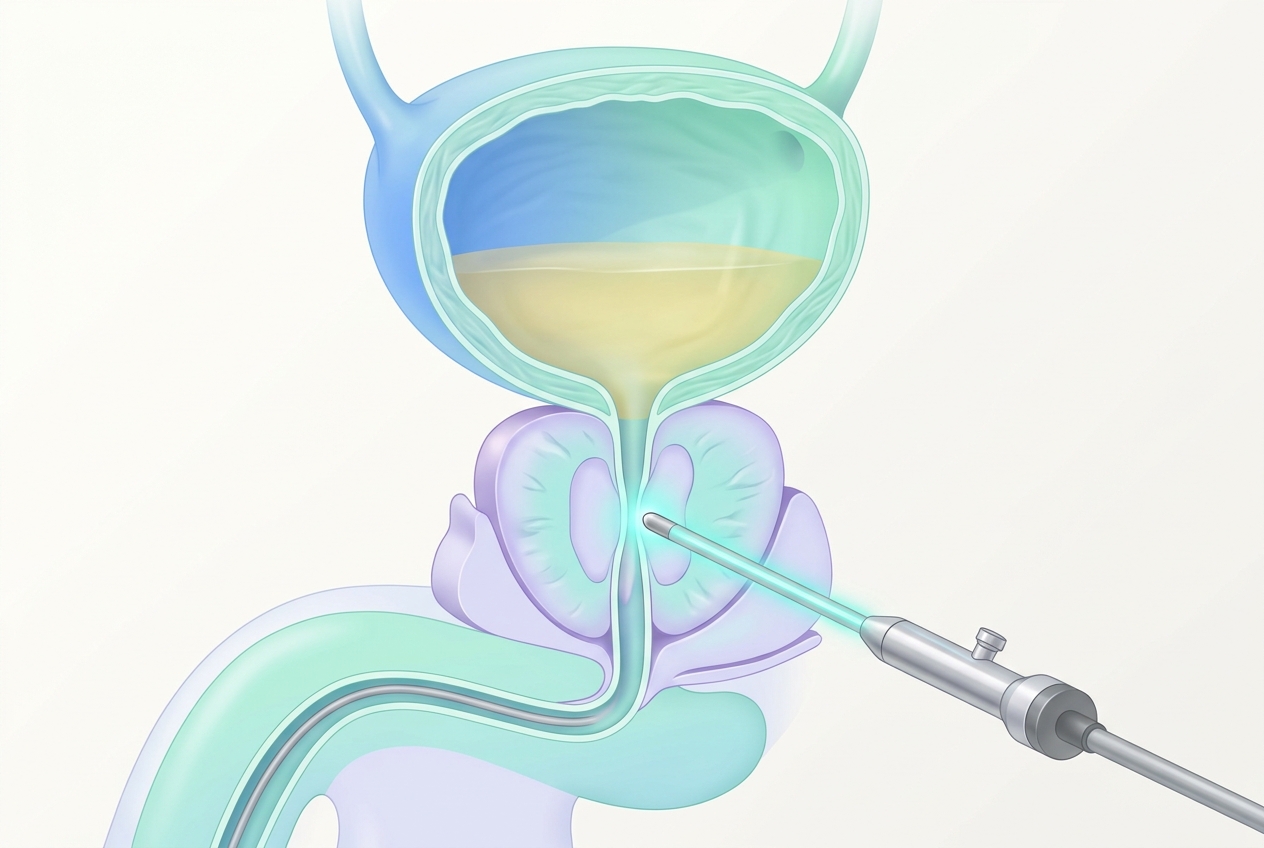
📋 Clinical Procedure Highlights
- Department: Soni Hospital Advanced Urology & Endosurgery Centre, Ramdaspeth, Nagpur.
- Surgical Technique: Minimally invasive laser, endoscopic, or microscopic intervention with tissue preservation.
- Anesthesia & Safety: State-of-the-art anesthesia with comprehensive pre-operative medical optimization.
- Insurance / TPA: Cashless claim pre-authorization supported for all major health insurance providers.
📋 Key Clinical Takeaways: HoLEP Laser Surgery
- The International Gold Standard: Recommended by the European Association of Urology (EAU) and American Urological Association (AUA) as the definitive treatment for BPH.
- Size-Independent Operation: Safely treats prostates of any volume (from 40g to >200g) completely endoscopically without open surgery.
- Near-Zero Re-Operation Rate: Because the entire adenoma is enucleated down to the true capsule, recurrence is under 1% over 10–20 years.
- Minimal Bleeding & Safe for Cardiac Patients: Superior laser coagulation allows safe treatment even for patients taking anticoagulant blood thinners.
- Rapid Discharge: Most patients have their catheter removed and go home within 24 to 48 hours.
Holmium Laser Enucleation of the Prostate (HoLEP) is widely acknowledged by urological authorities across the globe as the modern gold-standard surgical therapy for Benign Prostatic Hyperplasia. While earlier technologies focused on burning, vaporizing, or chipping away portions of the gland, HoLEP replicates the complete anatomical clearance of open surgery while remaining completely incision-free, scarless, and bloodless.
At Soni Hospital in Ramdaspeth, Nagpur, Senior Urologist Dr. Rajesh Soni is among the early pioneers of Holmium laser surgery in Central India. Having trained extensively in advanced endourology at MPUH Nadiad and leading academic centers in Vienna, Dr. Soni has performed thousands of successful laser prostatectomies. His surgical precision ensures complete obstruction relief, immediate recovery of urinary flow, and long-term protection of the bladder and kidneys.
Is HoLEP Laser Surgery Indicated for You?
HoLEP is the preferred surgical procedure for patients presenting with:
-
Large Prostates (>60 to 200+ Grams)
Massive prostate enlargement that would otherwise require an open abdominal operation. -
Recurrent Acute Urinary Retention
Episodes of total urinary blockage requiring repeated emergency catheterizations. -
Patients on Cardiac Blood Thinners
Individuals on Aspirin, Clopidogrel, or anticoagulants needing minimal bleeding risk. -
BPH Complicated by Bladder Stones
Simultaneous fragmentation of bladder stones and prostate enucleation in a single session. -
Persistent Incomplete Bladder Emptying
High post-void residual urine volumes (>150 mL) causing chronic bladder back-pressure. -
Desire for Permanent, Lifetime Relief
Patients wanting a one-time definitive procedure with near-zero (<1%) risk of tissue regrowth.
The Surgical Principle: Complete Anatomical Enucleation
The defining medical advantage of HoLEP is its adherence to natural anatomical planes. Think of an enlarged prostate as an orange: the outer rind is the surgical capsule, and the juicy fruit inside represents the overgrown adenoma compressing the urethra.
- TURP (Resection): Traditional TURP uses an electric wire loop to scoop out channels from inside the fruit, leaving substantial residual rind and adenoma behind.
- HoLEP (Enucleation): Dr. Rajesh Soni uses the Holmium laser beam like a scalpel to peel the entire fruit cleanly away from the capsule in its natural surgical cleavage plane. Every gram of obstructing tissue is separated into whole lobes, which are pushed into the bladder.
- Morcellation: A dedicated tissue morcellator enters the bladder and aspirates the floating lobes, mincing them into thin fragments for histopathological biopsy.
Comprehensive Clinical Comparison: HoLEP vs. TURP vs. Open Prostatectomy
| Clinical Parameters | HoLEP (Laser Enucleation) | Bipolar TURP (Resection) | Open Simple Prostatectomy |
|---|---|---|---|
| Incision / Scars | Zero (Natural Urethra) | Zero (Natural Urethra) | 8 – 12 cm Abdominal Incision |
| Prostate Size Limit | None (40g to >250g) | Best for <60g–80g | Typically for >100g only |
| Tissue Clearance | Complete (100% of adenoma) | Partial to Subtotal | Complete |
| Blood Loss & Transfusion | Extremely Low (<0.5%) | Low to Moderate (1–3%) | Moderate to High (10–15%) |
| Catheter Duration | 24 – 48 Hours | 48 – 72 Hours | 5 – 7 Days |
| Hospital Stay | 24 – 48 Hours | 2 – 3 Days | 5 – 7 Days |
| 10-Year Re-Operation Rate | <1% (Durable for life) | 10% – 15% (Tissue regrows) | 1% – 2% |
The Patient Journey at Soni Hospital, Nagpur
Pre-Operative Assessment & Sizing
Measurement of prostate volume on ultrasound/MRI, uroflowmetry, PSA verification, and pre-anesthetic cardiovascular clearance.
Laser Enucleation in Modular OT
Under spinal or general anesthesia, Dr. Rajesh Soni utilizes high-power Holmium laser energy to enucleate the prostate lobes cleanly off the capsule.
High-Speed Intravesical Morcellation
A specialized morcellator safely suctions and minces the enucleated tissue within the bladder, evacuating 100% of the specimen for laboratory biopsy.
Overnight Catheter Care & Step-Down
A temporary catheter provides gentle irrigation. Patients start an oral diet the same evening and walk comfortably around their room.
Catheter Removal & Discharge Home
The catheter is removed within 24 to 48 hours. Patients experience a forceful, effortless urinary stream and return home fully satisfied.
⚠️ Surgeon Note on Long-Term Outcomes
HoLEP is a true one-time definitive cure for BPH. Because the entire adenoma is cleared right down to the capsular boundary, there is virtually zero tissue remaining to regrow over your lifetime. Patients enjoy unobstructed urination, peaceful sleep, and freedom from prostate medications for decades to come.
Book HoLEP Laser Prostate Surgery Consultation
Direct consultation with Senior Consultant Urologist Dr. Rajesh Soni at Soni Hospital, Ramdaspeth, Nagpur. Complete the form below to send your consultation request directly to our clinical desk via WhatsApp for prompt confirmation.
Chat & Book via WhatsApp
Direct connection to Dr. Rajesh Soni's Desk
Common questions
Traditional TURP chips away pieces of the prostate from the inside out, often leaving behind substantial residual adenoma—especially in large glands—which can regrow over time (10–15% re-operation rate). HoLEP, by contrast, removes 100% of the obstructing tissue all the way to the surgical capsule, achieving durable results with a re-operation rate under 1% at 10 years, less bleeding, and shorter catheter duration.
Yes! HoLEP is completely "size-independent." In the past, massive prostates (>100 grams) required open surgery (simple open prostatectomy) with large abdominal cuts, significant bleeding, blood transfusions, and a 7-day hospital stay. With HoLEP, Dr. Rajesh Soni removes prostates weighing 100g, 150g, or even 250g entirely through the urethra without a single skin cut.
Yes. The Holmium laser has a shallow tissue penetration depth of just 0.4 mm and provides exceptional coagulation, instantly sealing blood vessels as enucleation proceeds. As a result, HoLEP has the lowest blood loss of any major prostate surgery and can be safely performed in patients on anticoagulants or antiplatelet agents with appropriate physician coordination.
Once the obstructing prostate lobes are laser-enucleated, they are pushed into the bladder. A precision instrument called a mechanical tissue morcellator is introduced through the nephroscope. It captures the floating lobes, minces them safely into fine tissue strips, and aspirates them out of the body, allowing complete pathological examination to rule out occult cancer.
In most patients, the urinary catheter is removed within 24 to 48 hours. Once the patient passes clear urine with a powerful stream, they are discharged home the very same day.
HoLEP preserves the external urinary sphincter and the erectile nerves situated outside the prostatic capsule. Temporary stress incontinence or urgency may occur in a small percentage of men with long-standing retention, but typically resolves within a few weeks with pelvic floor exercises. Erection quality is fully preserved; retrograde ejaculation (dry climax) occurs, which is medically harmless.